

Managing large-scale 3D rendering projects can drain your time and resources when the wrong server setup holds you back. You want render times to be fast, your workflow to be stable, and your team to access the power they need—no matter where they work. The right GPU server solution can make all the difference in hitting project milestones and staying productive.
This guide brings you real, actionable options to help you match your rendering needs with the best technology available. From dedicated servers that guarantee uninterrupted performance, to flexible cloud desktops and advanced virtual GPU setups, you will discover approaches that solve real challenges faced by creative professionals. Unlock faster rendering, smarter workflows, and reliable results—so your projects never have to stall waiting for computing power.
Quick Summary
| Takeaway | Explanation |
|---|---|
| 1. Utilize Dedicated GPU Servers | Ensure exclusive computing resources for uninterrupted rendering and optimized performance without competition from other users. |
| 2. Explore Virtualized GPU Servers | Achieve flexibility and scalability for your rendering projects, adjusting resources dynamically based on workload demands. |
| 3. Implement Hybrid GPU-CPU Servers | Benefit from balanced computational power by effectively distributing tasks between GPUs and CPUs for enhanced performance. |
| 4. Leverage Render Farm GPU Servers | Scale up rendering capabilities for large animation projects by processing multiple frames simultaneously across many servers. |
| 5. Select Customizable GPU Servers | Tailor server configurations to precisely match project needs, ensuring optimized performance and cost-efficiency. |
1. Dedicated GPU Servers for Uninterrupted Rendering
When it comes to high-performance 3D rendering, dedicated GPU servers represent the gold standard for professional studios seeking uninterrupted computational power. These specialized machines are engineered to handle intense graphics processing tasks with precision and reliability.
Dedicated GPU servers offer several critical advantages for rendering professionals:
- Guaranteed full hardware resources without performance throttling
- Enterprise-grade Nvidia and AMD graphics processors
- High bandwidth network connections
- European data center proximity ensuring low latency
Unlike shared hosting environments, dedicated GPU servers provide exclusive computing resources that eliminate performance bottlenecks. This means your rendering projects can run continuously without competing with other users’ workloads.
Dedicated GPU servers guarantee consistent performance critical for complex rendering workflows.
Professional 3D artists and animation studios benefit tremendously from these servers by achieving faster render times, more predictable project timelines, and significantly reduced computational interruptions. The ability to configure servers with precisely the GPU configurations needed for specific projects makes these solutions incredibly flexible.
Pro Tip: Always verify the specific GPU models and memory configurations before selecting a dedicated server to ensure optimal rendering performance for your specific software and project requirements.
2. Virtualized GPU Servers for Flexibility and Scaling
Virtualized GPU servers represent a cutting-edge solution for 3D rendering professionals seeking maximum computational adaptability. These advanced server environments leverage sophisticated technologies to transform how graphics-intensive workloads are processed and managed.
The core innovation behind GPU cloud computing involves NVIDIA Multi-vGPU technology, which enables remarkable resource optimization:
- Dynamic allocation of graphics processing power
- Multiple virtual machines accessing shared GPU resources
- Scalable computational capabilities on demand
- Efficient performance across complex rendering tasks
Virtual GPU servers provide unprecedented flexibility for rendering workflows that require rapid computational scaling.
Unlike traditional dedicated servers, virtualized GPU environments allow studios to adjust computational resources instantaneously. This means you can scale up processing power during intensive rendering projects and scale down during lighter workloads, optimizing both performance and cost-effectiveness.
Professional 3D artists benefit from these servers by gaining the ability to tackle complex rendering challenges without maintaining expensive permanent infrastructure. The dynamic nature of virtualized GPU servers ensures that computational resources are always precisely matched to project requirements.
Pro Tip: Carefully analyze your rendering workflow and choose virtualized GPU configurations that match your specific software and project complexity to maximize computational efficiency.
3. Hybrid GPU-CPU Servers for Balanced Workloads
Hybrid GPU-CPU servers represent a sophisticated computing solution that transforms how complex rendering tasks are processed. These innovative server architectures intelligently combine the strengths of central processing units and graphics processing units to deliver unprecedented computational performance.
By leveraging advanced workload distribution techniques, these hybrid servers offer remarkable advantages:
- Dynamic task scheduling between CPUs and GPUs
- Optimized memory usage and resource allocation
- Enhanced performance for scientific simulations
- Improved throughput for graphics-intensive applications
Hybrid servers balance computational power by intelligently decomposing complex rendering tasks across different processing units.
Unlike traditional single-architecture servers, hybrid GPU-CPU environments can dynamically allocate computational resources based on specific workload requirements. This means your rendering projects can benefit from the sequential processing power of CPUs and the parallel computation capabilities of GPUs simultaneously.
Professional 3D rendering studios can achieve significant performance gains by adopting these flexible server architectures. The ability to distribute computational tasks intelligently ensures faster render times and more efficient resource utilization.
Pro Tip: Always analyze your specific rendering workflow to determine the optimal GPU-CPU ratio that matches your project complexity and performance requirements.
4. Render Farm GPU Servers for Large-Scale Animation
Render farm GPU servers represent the ultimate computational powerhouse for animation studios tackling massive rendering projects. These specialized server environments transform complex animation workflows by distributing intensive rendering tasks across multiple high-performance graphics processing units.
Professional animation studios leverage render farm workflows to achieve extraordinary computational capabilities:
- Parallel processing of complex animation frames
- Dramatically reduced rendering time for full-length projects
- Scalable infrastructure supporting multiple simultaneous renders
- Cost-effective solution for managing large-scale production
Render farm GPU servers enable animation studios to transform time-consuming rendering processes into streamlined, efficient workflows.
Unlike traditional single-server setups, render farm environments allow studios to break down complex animation sequences into smaller computational tasks. This distributed approach means that hundreds or even thousands of individual frames can be rendered simultaneously across multiple GPU servers.
Animation teams can now tackle projects that would have been impossible just a few years ago. High-resolution, visually complex animations that once took weeks or months can now be completed in a fraction of the time.
Pro Tip: Strategically configure your render farm GPU servers by balancing computational power with network infrastructure to maximize rendering efficiency and minimize potential bottlenecks.
5. Cloud Desktops with GPU for Interactive Workflows
Cloud desktops with GPU represent a revolutionary approach to empowering creative professionals with flexible, high-performance computing environments. These virtual workstations enable seamless graphics-intensive work from anywhere in the world.
Professionals can now access cloud desktop services that deliver remarkable capabilities:
- Instant access to powerful GPU-enabled workstations
- Multi-monitor support for complex design workflows
- Secure centralized data management
- Remote collaboration across geographic boundaries
- Scalable performance profiles for varying project needs
Cloud desktops with GPU transform traditional computing limitations into boundless creative opportunities.
Unlike traditional hardware setups, these virtual environments allow 3D artists, designers, and engineers to work with high-end graphics processing capabilities without investing in expensive local hardware. Your workstation becomes location independent, adaptable to your changing professional requirements.
The technology enables instant provisioning of powerful graphics resources, meaning you can start complex rendering or design tasks within minutes of logging in. This flexibility dramatically reduces upfront technology investments and ongoing maintenance costs.
Pro Tip: Evaluate your specific workflow requirements carefully and select a cloud desktop service that offers GPU configurations matching your most demanding professional applications.
6. AI-Optimized GPU Servers for Smart Rendering Tasks
AI-optimized GPU servers represent the next frontier of computational intelligence for 3D rendering workflows. These advanced server environments leverage artificial intelligence to dramatically transform how rendering tasks are processed and optimized.
Professional studios can benefit from GPU servers for machine learning through several groundbreaking capabilities:
- Intelligent task distribution and prioritization
- Automatic rendering quality optimization
- Predictive rendering time estimation
- Machine learning-enhanced noise reduction
- Adaptive computational resource allocation
AI-powered GPU servers transform traditional rendering from a linear process into an intelligent, self-optimizing workflow.
Unlike traditional rendering approaches, these servers use machine learning algorithms to analyze and predict rendering requirements in real time. This means your computational resources are dynamically adjusted to maximize efficiency and minimize processing time.
The integration of artificial intelligence into GPU servers enables unprecedented levels of rendering intelligence. Studios can now leverage smart algorithms that learn from previous rendering jobs, continuously improving performance and output quality.
Pro Tip: When selecting an AI-optimized GPU server, prioritize platforms with robust machine learning capabilities and transparent performance metrics to ensure optimal rendering outcomes.
7. Customizable GPU Servers to Match Project Needs
Customizable GPU servers represent the ultimate solution for 3D rendering professionals seeking precision-tailored computational resources. These flexible server environments allow studios to design computing infrastructure that perfectly matches their unique project requirements.
Professional rendering teams can leverage dedicated cloud hosting with remarkable configuration options:
- Full hardware specification control
- Granular GPU selection capabilities
- Scalable memory and processing configurations
- Instant deployment of custom server environments
- Transparent pricing for tailored solutions
Customizable GPU servers transform computational infrastructure from a one-size-fits-all model to a precision-engineered rendering platform.
Unlike traditional server solutions, these customizable environments enable you to select exact GPU models, memory capacities, and processing capabilities that align perfectly with your specific rendering workflow. Whether you are working on high-resolution architectural visualizations or complex animation sequences, you can craft a server environment that meets your exact specifications.
The ability to fine-tune server configurations means reduced overhead, optimized performance, and more efficient resource allocation. Studios can now move beyond generic hardware solutions and create computational environments that feel like purpose-built rendering machines.
Pro Tip: Conduct a thorough analysis of your rendering workflow before configuring your custom GPU server to ensure you select components that provide maximum performance and cost-effectiveness.
Below is a detailed table summarizing the types of GPU servers described in the article, including their features, advantages, and professional applicability.
| Server Type | Features | Professional Applicability |
|---|---|---|
| Dedicated GPU Servers | Full hardware access, enterprise-grade GPUs, proximity to data centers. | Suitable for uninterrupted 3D rendering with high predictability. |
| Virtualized GPU Servers | Dynamic resource allocation, scalable, shared GPU access. | Ideal for projects with variable computational needs and scaling. |
| Hybrid GPU-CPU Servers | Task allocation across CPUs and GPUs, optimized resource use. | Effective for balanced workloads such as simulations and 3D workflows. |
| Render Farm GPU Servers | Distributed GPU processing, parallel rendering, large-scale task handling. | Optimal for complex animation and large rendering projects. |
| Cloud Desktops with GPU | Remote access, secure centralized management, adaptable computing profiles. | Facilitates location-independent 3D design and real-time collaboration. |
| AI-Optimized GPU Servers | Self-optimizing workflows using AI, machine-learning enhancements. | Efficient for tasks benefiting from predictive analysis and optimization. |
| Customizable GPU Servers | Tailorable hardware specs, granular configuration options. | Perfect for projects requiring precise, project-specific solutions. |
Unlock Seamless 3D Rendering with MaxCloudON’s GPU Server Solutions
Struggling to find GPU servers that precisely match your rendering needs as outlined in the “7 Essential Types of GPU Servers for 3D Rendering” article? MaxCloudON understands the critical challenges of balancing performance, flexibility, and scalability in high-intensity 3D workflows. Whether you need dedicated GPU servers for uninterrupted power, virtualized GPUs for flexible scaling, or fully customizable configurations tailored to your project demands, MaxCloudON delivers with precision and reliability.
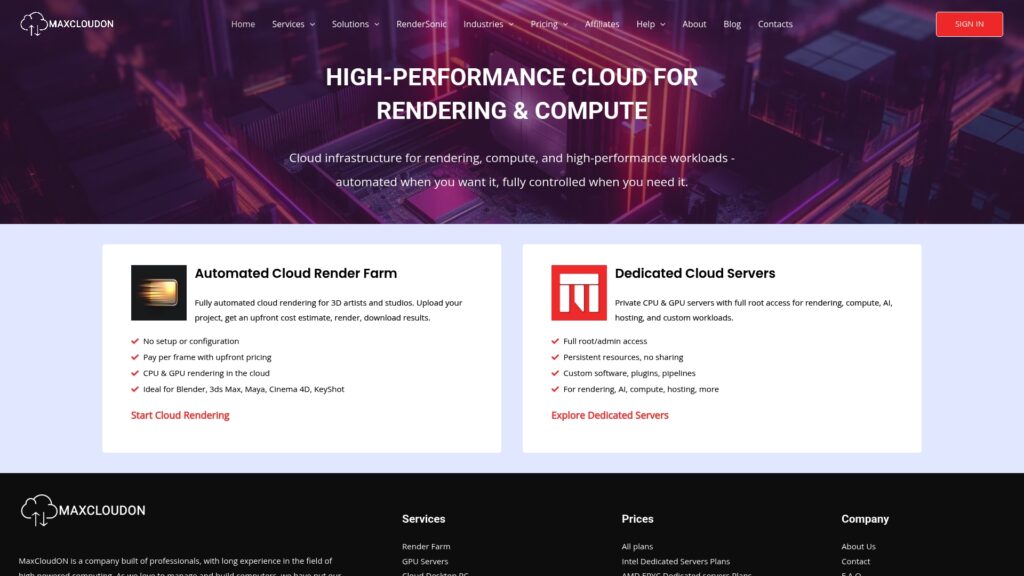
Explore our carefully engineered cloud infrastructure designed to eliminate bottlenecks and accelerate your projects. Visit MaxCloudON to discover instant deployment of GPU and CPU servers with full control and transparent pricing. For hands-on guidance and expert tips on harnessing Nvidia GPUs for rendering, check out our Your Guide to Nvidia Products, Features and Tutorials. Ready to transform your rendering workflow with the power of cloud servers optimized for real-time collaboration? Start now by exploring our Tutorials Archives – MaxCloudON and unlock your creative potential today.