
Free rendering services may seem cost-effective at first, but their limitations in rendering speed, quality, scalability, and reliability often create bigger problems than they solve. Slow queues, restricted features, lower visual fidelity, and potential security risks make free platforms unsuitable for professional 3D work. For fast, consistent, and production-ready results, using a reliable cloud render farm is the more efficient alternative.
The idea of getting something for free is naturally appealing – especially in 3D rendering, where hardware costs, licensing fees, and long render times can add up quickly. Free rendering services provide a cost-effective solution for 3D artists and small studios who want to visualize their work but cannot yet invest in their own hardware or pay for cloud render services.
For newcomers or those on limited budgets, free rendering can seem like the perfect solution. The initial cost savings free up resources for other areas of a project or business. However, the question remains: Are free rendering services truly worth it, and can they support professional-level work?
The Attraction of Free Rendering
The word free draws in many users looking to reduce costs – especially in fast-paced 3D production environments where delivering high-quality visuals under tight deadlines is the norm. On the surface, a free rendering service looks like a dream come true. But the trade-offs in rendering speed, flexibility, and output quality often become apparent very quickly.
Evaluating No-Cost Solutions
While skipping upfront costs is tempting, free rendering services may not provide the output quality expected for commercial or client-facing work. Reduced rendering speed, queue limits, and restricted tools can slow down production. Moreover, these platforms may lack advanced rendering features needed for realistic lighting, detailed materials, and complex simulation workloads.
Immediate Benefits
Free services are attractive because there’s no initial spend. However, the trade-off is real: slower renders, restricted settings, and the absence of advanced rendering features for complex lighting, high-res textures, and heavy scenes. These factors can lead to missed deadlines, re-renders, and reduced final quality – which ultimately cost more in time than money saved.
Quality Concerns
Free platforms frequently operate on a “good enough” model. For hobby projects, this may be acceptable – but for portfolios, client deliverables, or studio pipelines, consistency and quality matter.
- Longer render times can delay delivery schedules.
- The final output may lack realism and fine details.
- The rendering process may require compromises in lighting, textures, or resolution.
- Output may fail to meet professional presentation standards
This directly affects your portfolio, client trust, and reputation.
Compromised Rendering Capabilities
Free rendering platforms rarely match the power of dedicated workstations or cloud render farms. They often struggle with high-poly scenes, high-resolution textures, complex lighting setups and animation sequences. Free platforms limit what you can create – and how fast you can deliver it.
Impact on Visual Effects and Detailing
VFX workflows and detailed 3D visualization rely on precision to convey depth, atmosphere, and realism. Free render services often flatten lighting, reduce texture fidelity, and struggle with simulation-heavy scenes. The result is visuals that look less polished and lack the cinematic or realistic quality clients expect.
Hidden Costs: What are the Unseen Expenses
The absence of upfront fees can be misleading. Over time, the hidden costs of free rendering services often outweigh initial savings:
- Time wasted waiting for slow renders to finish
- Re-rendering work due to poor quality output
- Client revisions caused by inconsistent visual results
The time inefficiency alone can become more expensive than simply using a scalable cloud render farm that delivers predictable performance.
Time-Consuming Workarounds
To compensate for free service limitations, artists may need to split scenes into smaller pieces, reduce resolution or texture size, repeatedly tweak render settings manually. This wastes hours and disrupts production flow – negating any “free” advantage.
Additional Expenses Over Time
Eventually, users may need to invest in more powerful hardware or external services to compensate for the limitations of free solutions. Missed deadlines or inconsistent quality can also lead to lost clients – and lost revenue. These long-term costs can far exceed the price of investing in a reliable, paid rendering service from the outset.
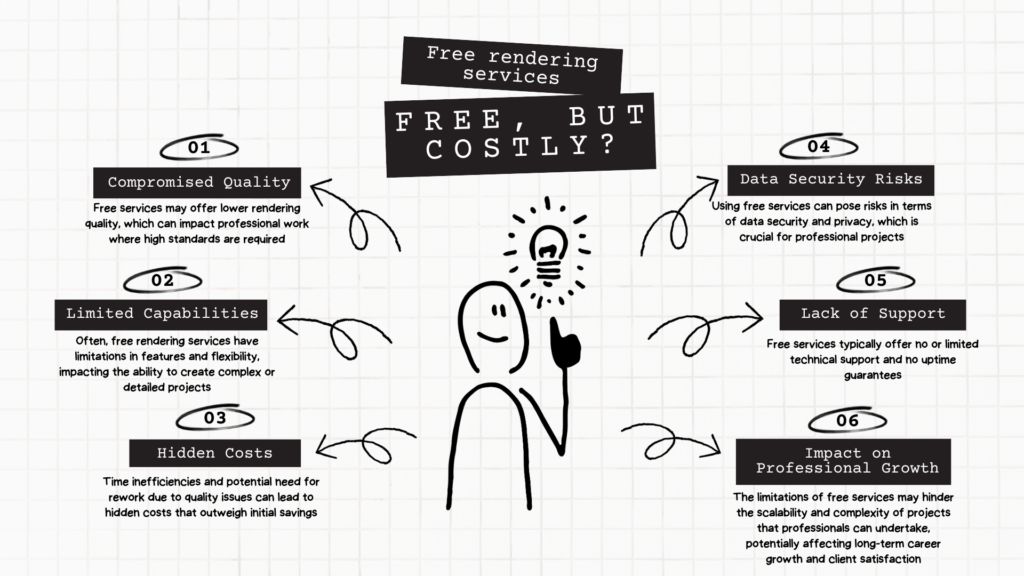
Free rendering services – Limitations in Features and Flexibility
Free rendering services often come with restrictions that directly impact workflow quality and creative output. Limitations typically include restricted render settings, limited engine compatibility, and a lack of support. These constraints can prevent professionals from fully realizing the detail and visual depth their projects require.
Key limitations to consider:
- Lack of advanced features and customization: Free rendering services support only basic settings, which can be insufficient for complex or highly detailed projects. Advanced software features, such as custom shaders, high-resolution textures, and sophisticated lighting options, are commonly locked behind paid plans. This limits realism and creative direction.
- Scalability constraints: Large architectural scenes, VFX-heavy animation sequences, and high-poly assets require substantial processing power. Free platforms typically cap project size or memory usage, preventing professionals from scaling up. Artists may eventually require infrastructure like dedicated GPU servers for unshared, high-performance rendering power.
Data Security Risks in Free Rendering Services
You should stay alert to the potential data security risks when using free rendering services. Rendering requires uploading project files – which often include proprietary assets, client materials, IP-sensitive designs, or incomplete work. Free services may not provide:
- Encrypted storage standards
- Private render nodes
- Compliance certifications
- Verified data handling policies
This increases the risk of unauthorized access, asset leakage, accidental deletion, or third-party reuse of uploaded content.
In professional environments, a data breach is not just inconvenient – it can lead to lost clients, contract violations, and damaged reputation.
Compliance and Privacy Concerns
Even when no data breach occurs, free rendering services may still pose compliance risks. Many do not meet specific regulation or NDA-controlled workflows. For professionals working with client-owned assets, architectural plans, product designs, or medical/industrial visualization, this can create legal and contractual exposure.
For industries requiring confidentiality or regulatory compliance, free platforms are rarely acceptable from a legal or professional standpoint.
Support and Reliability: Often Overlooked Aspects
Technical support and service reliability are critical in 3D workflows – yet they are often overlooked when choosing free rendering options. Free platforms typically provide little to no support, meaning that if something breaks, crashes, or fails mid-render, you are on your own.
Additionally, free render services generally do not guarantee uptime or performance consistency. Render queues may be slow or overloaded, and performance can fluctuate depending on how many other users are rendering at the same time. For client-facing projects with fixed delivery deadlines, these delays can be costly.
Key considerations:
- Support availability: Dedicated support is essential for resolving issues that may arise during the rendering process. Free rendering often offer limited or no support, so troubleshooting falls entirely on you.
- Reliability and uptime: Free rendering services typically do not offer uptime guarantees, which can lead to unexpected outages and delays.
Long-Term Implications for Professional Projects
Free rendering services might look like a good deal now, but they can cause problems for professional work later. They may worsen the quality and timing of projects and damage your career and reputation if using such services.
Concerns:
- Professional reputation and client trust: Clients expect consistent, high-quality visual results. If the rendering platform limits texture detail, lighting accuracy, or speed, the final output may appear unfinished or low-quality. Delivering substandard results even once can lead to lost repeat business, damaged portfolio credibility or lower perceived expertise. Maintaining a professional reputation requires reliability – something free platforms often cannot ensure.
- Future Growth and Scalability: As projects get larger and more complex, resource demands increase. Free platforms do not scale – meaning performance stays the same while your workload grows. This can eventually block your ability to take on larger projects, deliver complex scenes or multi-shot animations, or produce highly detailed visualization work. When scaling becomes necessary, professionals often transition to a cloud render farm environment that supports flexible capacity and workload growth.
Alternatives to Free Rendering Services: What to Use Instead
After exploring the risks and limitations of free rendering services, it becomes clear that once rendering speed, output quality, and workflow consistency start to matter, these platforms quickly fall short. Professional 3D workflows require stable, scalable, and efficient infrastructure to maintain predictable performance, full control over render settings, and the ability to scale compute power as projects grow.
Here are the most practical alternatives for 3D artists and studios who need reliable, secure and affordable rendering:
Cloud Render Farm for On-Demand Power
A cloud render farm provides access to high-performance compute resources that dramatically reduce render times. It allows you to process large scenes, high-resolution textures, and animation sequences without overloading your local workstation.
Fully Automated Online Rendering with RenderSonic
Automated online rendering can eliminate the manual setup of render nodes, file paths, and job management. RenderSonic automates rendering workflow, handles scene preparation and job distribution. No configuration required – ideal for batch rendering, animations, or overnight processing.
They allow you to leverage advanced render engines and GPU acceleration without investing in expensive hardware. Additionally, resources can be scaled up or down as needed, so you only pay for what you use.
Rent Dedicated GPU Servers For Full Control
For studios and 3D artists requiring specific GPU models, plugin versions, or custom pipelines, renting dedicated GPU severs provides unshared performance and predictable output. This is the closest experience to owning your own render hardware – without the upfront hardware investment.
This option eliminates compatibility issues and enables complete customization of the rendering environment, including your preferred 3D rendering software and render settings setup.
While dedicated servers come at a higher cost, they deliver consistent speed, advanced feature support, and scalability for demanding professional workflows.
Comparing Costs and Benefits: Free vs Paid Rendering Solutions
When comparing free rendering services with professional alternatives, it’s important to look beyond the lack of upfront cost. While free platforms can be useful for testing or learning, their limitations in speed, reliability, and scalability often make them unsuitable for commercial or studio use.
In contrast, paid solutions such as cloud render farms, automated rendering platforms like RenderSonic, and dedicated cloud servers offer consistent performance, full control over settings, and the ability to scale resources based on project demands.
Below is a practical comparison outlining how these options differ in performance, cost efficiency, and professional readiness.
| Feature / Aspect | Free Rendering Services | Cloud Render Farm | RenderSonic (Automated Cloud Rendering) | Dedicated Cloud Servers |
|---|---|---|---|---|
| Cost | No upfront cost, but hidden expenses (time, delays, re-renders) | Pay-per-use or subscription; transparent pricing | Pay-per-render; fully-automated setup and processing | Monthly/weekly/daily rental; full resource control |
| Performance | Limited compute power and slow render queues | High-performance CPU/GPU nodes | Optimized automation for fast cloud rendering | Maximum performance with unshared dedicated hardware |
| Scalability | Restricted scene size and memory | Instantly scalable; supports multi-node rendering | Auto-scaling during heavy render tasks | Full scalability; user-defined performance levels |
| Ease of Use | Requires manual setup and adjustments | Simple setup; user-managed scene uploads | Fully automated rendering and job management | Requires setup knowledge; best for technical users |
| Render Quality | Often reduced lighting, lower resolution, limited textures | Supports all major render engines; consistent quality | Uses the same engines but automated for convenience | Full control over engines, plugins, and configurations |
| Data Security | Minimal protection; potential privacy risks | Encrypted file transfer and private rendering environment | Secure cloud environment with automatic file management | Highest security; full data isolation on dedicated servers |
| Support | Community-only | Professional support with uptime guarantees | Managed workflow with active monitoring | Direct support and remote access for custom configurations |
| Ideal For | Beginners, tests, small personal projects | Freelancers and studios seeking speed and scalability | 3D artists needing automated, hands-off rendering | Advanced users requiring full customization and control |
Conclusion
Free rendering services can be useful for testing, learning, or small personal projects. However, when deadlines, visual quality, and consistency start to matter, the limitations become difficult to ignore. Reduced performance, restricted features, lack of support, and security risks can slow workflow and compromise the final outputs, which affects both client satisfaction and long-term professional credibility.
For artists, studios, and 3D teams who rely on predictable output and efficient workflows, it is more effective to rely on cloud infrastructure designed for production-level rendering. Scalable solutions such as a cloud render farm provide the performance headroom, flexibility, and reliability needed to handle complex scenes, high-resolution textures, and animation workloads without sacrificing time or quality.
Choosing the right rendering workflow is not just about cost – it’s about ensuring that your tools support your creative goals, production timelines, and professional growth. The best rendering setup is one that scales with you, rather than holding you back.
Frequently Asked Questions:
What are the hidden costs of free rendering services?
While free rendering services have no upfront cost, they often introduce hidden expenses over time. These may include slower render processing, time lost troubleshooting errors, re-rendering due to inconsistent output quality, and project delays caused by queue limitations. In professional workflows, the time lost can cost more than investing in a scalable rendering solution.
Why is the output quality lower with free rendering services?
Free platforms typically restrict resolution, texture size, lighting complexity, and render settings. This can lead to flat lighting, reduced detail, and less realistic final output. Paid render solutions allow full control over rendering parameters, producing higher-quality visuals suitable for client and studio work.
Do free rendering services support complex or large-scale projects?
Most free services are limited in memory usage, scene size, or project duration. They often struggle with VFX shots, animation sequences, high-poly environments, and large architectural scenes. Professionals working with complex visuals generally rely on scalable infrastructure, such as a cloud render farm for consistent performance.
Are free rendering services safe for client or confidential work?
Free platforms do not provide guarantees regarding data storage, encryption, privacy controls, or compliance. Projects containing proprietary assets, architectural plans, product designs, or NDA-restricted material may be at risk. Paid rendering environments typically offer controlled data handling and private compute resources.
Some extra read on the matter: 4 Limitations of Current Rendering Software and What We Can Expect in the Future