

Running demanding AI research and large-scale experiments brings a unique set of technical headaches. Everything from unpredictable performance spikes to hidden security vulnerabilities can throw off your workflow and undermine your results. You need a platform built for advanced computing that stays reliable and adapts to your needs as your projects grow in complexity.
This list will show you how dedicated cloud servers address these challenges head-on. You’ll learn the concrete benefits that help researchers like you unlock unwavering computational power, protect sensitive data, and maintain transparent costs – without compromising on flexibility or speed.
Get ready to discover actionable strategies and expert tips that can transform your AI research environment. Each insight offers a practical step forward toward more efficient, secure, and scalable scientific work.
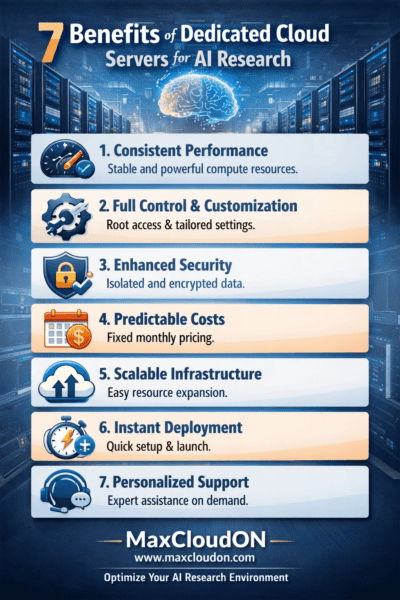
Quick Summary
| Takeaway | Explanation |
|---|---|
| 1. Consistent Performance Ensures Reliability | Dedicated cloud servers provide stable computational resources, crucial for complex AI tasks and large-scale analyses. |
| 2. Full Control Boosts Efficiency | Researchers gain root access and can customize server settings, optimizing systems for specific computational needs. |
| 3. Enhanced Security for Sensitive Data | Dedicated hardware isolates resources, offering robust security measures that safeguard sensitive research data and processes. |
| 4. Predictable Costs Aid Budget Planning | Fixed monthly expenses and transparent pricing structures enable researchers to manage finances and avoid unexpected costs. |
| 5. Rapid Deployment for Quick Experimentation | Instant deployment of resources accelerates research workflows, enabling fast experimental iterations without hardware delays. |
1. Consistent High Performance for Compute Tasks
AI researchers demand computing environments that deliver unwavering computational power without performance interruptions. Unlike shared cloud infrastructures that fluctuate based on multiuser loads, dedicated cloud servers provide predictable and stable computational resources specifically tailored for intensive research workloads.
The significance of consistent performance becomes critically apparent when running complex machine learning models or conducting large-scale data analysis. High performance compute workloads require dynamic scaling capabilities that eliminate computational bottlenecks and ensure uninterrupted research progression.
Key advantages of dedicated cloud performance include:
- Guaranteed resource allocation without contention
- Predictable processing speeds for complex algorithms
- Reduced latency during computation-intensive tasks
- Reliable environment for reproducible scientific experiments
Researchers can optimize their workflows by selecting dedicated servers with precisely configured CPU and GPU specifications matching their specific computational requirements. This targeted approach eliminates shared infrastructure limitations and provides a stable platform for conducting advanced AI research.
Consistent performance isn’t just about speed – it’s about creating a reliable research ecosystem where computational resources adapt seamlessly to your scientific objectives.
Pro Tip: Before selecting a dedicated cloud service, always request detailed performance benchmarks specific to your research domain to ensure optimal computational alignment.
2. Full Control and Customization of Server Settings
Dedicated cloud servers empower AI researchers with unprecedented administrative flexibility, offering granular control over every aspect of their computational environment. Unlike restrictive shared hosting platforms, these specialized servers provide root-level access that transforms how scientific computing workflows are designed and executed.
The ability to customize server settings enables researchers to create precisely tailored computing ecosystems that match their unique computational requirements. This level of configuration goes far beyond standard cloud offerings and allows for deep optimization of hardware resources.
Key customization capabilities include:
- Complete root/admin access permissions
- Flexible kernel and operating system selection
- Custom network configuration options
- Precise hardware resource allocation
- Advanced security parameter modifications
- Personalized software stack deployment
Researchers can strategically configure their servers to minimize computational overhead and maximize performance efficiency. By having direct control over system parameters, you can eliminate unnecessary background processes and allocate computing resources precisely where they are most needed.
True research innovation requires computational environments that adapt to your specific scientific requirements rather than constraining your work within predefined limitations.
With dedicated servers, you transform your infrastructure from a generic computing platform into a specialized research instrument precisely calibrated to your scientific objectives.
Pro Tip: Document your server configurations meticulously to ensure reproducibility and enable seamless environment recreation for collaborative research projects.
3. Enhanced Security with Dedicated Hardware
AI researchers handling sensitive data require computational environments that offer robust multilayered security protections. Dedicated hardware servers provide an unprecedented level of isolation and protection that shared cloud infrastructures simply cannot match.
Managed dedicated servers deliver comprehensive security features specifically designed to safeguard critical research data and computational processes. Unlike shared environments where multiple users potentially compromise system integrity, dedicated hardware creates an exclusive computational fortress for your scientific work.
Key security advantages include:
- Complete hardware resource isolation
- Advanced intrusion detection systems
- Customizable firewall configurations
- DDoS protection mechanisms
- Granular access control permissions
- Encrypted data transfer protocols
- Independent security parameter management
Researchers can implement multiple security layers by leveraging dedicated hardware’s inherent architectural advantages. This approach transforms your computational infrastructure from a potential vulnerability into a secure research platform that protects intellectual property and sensitive scientific discoveries.
Security in AI research is not just about preventing unauthorized access – it’s about creating an impenetrable environment where scientific innovation can flourish without compromise.
Pro Tip: Regularly audit and update your server’s security configurations to maintain a proactive defense against emerging technological vulnerabilities.
4. Predictable Resource Allocation and Costs
AI researchers require computational environments that offer transparent and predictable financial models. Dedicated cloud servers transform resource allocation from an unpredictable expense into a strategic investment with clear budgetary boundaries.
Predictive resource allocation techniques revolutionize how AI computational resources are managed and optimized. These advanced frameworks enable researchers to forecast computational demands with unprecedented accuracy while maintaining strict cost controls.
Key advantages of predictable resource allocation include:
- Fixed monthly infrastructure expenses
- Precise computational resource mapping
- Elimination of unexpected cost overruns
- Transparent pricing structures
- Granular budget management controls
- Accurate long-term financial planning
By leveraging dedicated hardware environments, researchers can design computational strategies that align technological requirements with financial constraints. This approach transforms cloud computing from a potential financial risk into a controlled and strategic research investment.
Predictable resource allocation is not just about managing costs – it’s about creating a stable computational ecosystem where scientific innovation can thrive without financial uncertainty.
Researchers can implement intelligent allocation strategies by continuously monitoring computational requirements and adjusting resources proactively. This method ensures maximum efficiency while maintaining strict budgetary discipline.
Pro Tip: Develop quarterly computational forecasting models to anticipate resource needs and optimize your cloud infrastructure spending.
5. Scalable Infrastructure for Growing Workloads
AI researchers require computational environments that can dynamically expand with research complexity. Dedicated cloud infrastructures offer unprecedented flexibility to scale computational resources precisely when and how you need them.
Scalable distributed AI frameworks transform research capabilities by providing elastic infrastructure that adapts to evolving computational demands. These advanced systems enable researchers to seamlessly adjust processing power without disrupting ongoing scientific investigations.
Key scalability advantages include:
- Instant resource provisioning
- Flexible GPU and CPU allocation
- Linear performance scaling
- Zero downtime infrastructure expansion
- Cost-effective computational growth
- Automated resource optimization
- Seamless workload migration
Researchers can design computational strategies that grow organically with their project requirements. This approach eliminates traditional infrastructure limitations and allows scientific exploration without technological constraints.
Scalability is not just about adding more computing power – it’s about creating an intelligent research ecosystem that evolves alongside your scientific ambitions.
By leveraging cloud-native architectures with containerization and microservices, AI researchers can create modular computational environments that respond dynamically to emerging research challenges.
Pro Tip: Implement infrastructure-as-code strategies to enable rapid and reproducible computational resource scaling across your research projects.
6. Instant Deployment for Rapid Experimentation
AI researchers require computational environments that enable lightning-fast experimental iterations. Dedicated cloud infrastructures transform traditional research workflows by eliminating time-consuming hardware procurement and configuration processes.
On-demand GPU resource access revolutionizes how scientific experiments are designed and executed. Researchers can now spin up complex computational environments within minutes rather than weeks or months.
Key advantages of instant deployment include:
- Zero hardware procurement delays
- Immediate computational resource activation
- Seamless environment configuration
- Rapid prototype testing capabilities
- Minimal infrastructure management overhead
- Consistent performance across experimental stages
- Flexible resource allocation
By leveraging dedicated cloud platforms, researchers can focus more on scientific discovery and less on technological setup. This approach dramatically accelerates the pace of AI research by removing traditional infrastructure barriers.
Instant deployment is not just a technological convenience – it’s a fundamental transformation of how scientific exploration happens in the digital age.
Researchers can design modular experimental frameworks that can be rapidly deployed across different computational environments ensuring maximum flexibility and minimal friction.
Pro Tip: Develop standardized deployment scripts to further reduce configuration time and ensure reproducible research environments.
7. Personalized Support for Complex Applications
AI researchers require more than just computational infrastructure they need dedicated expert guidance tailored to their unique scientific challenges. Dedicated cloud platforms distinguish themselves by offering specialized support that goes far beyond standard technical assistance.
Academic AI support frameworks transform technical support from a reactive service into a proactive research partnership. These personalized support models understand the nuanced requirements of advanced scientific computational environments.
Key advantages of personalized support include:
- Direct access to specialized technical experts
- Rapid problem resolution for complex workflows
- Customized infrastructure optimization strategies
- Contextual guidance for research-specific challenges
- Proactive performance monitoring
- Advanced troubleshooting capabilities
- Research workflow consultation services
By providing targeted support, dedicated cloud platforms enable researchers to focus on scientific discovery rather than technological troubleshooting. This approach treats computational infrastructure as an intelligent research ecosystem rather than a mere technical utility.
Personalized support is not just about fixing problems – it’s about creating an collaborative environment that accelerates scientific innovation.
Researchers can leverage these support frameworks to transform potential technological obstacles into strategic research advantages.
Pro Tip: Document your unique computational requirements comprehensively to enable more precise and targeted support interactions.
Below is a comprehensive table summarizing the benefits and features of dedicated cloud servers for AI research discussed throughout the article.
| Aspect | Key Features | Advantages |
|---|---|---|
| Consistent High Performance | Guaranteed resource allocation; Predictable processing speeds | Ensures stable workloads; Reduces latency |
| Customization and Control | Root access and hardware configuration | Tailored to project tasks; Reduces overhead |
| Enhanced Security | Intrusion detection; Encrypted data transfer | Safeguards sensitive data; Prevents unauthorized access |
| Predictable Costs | Fixed monthly expenses; Precise resource mapping | Improves budget tracking; Avoids cost spikes |
| Scalability | Dynamic resource provisioning; Zero downtime expansion | Supports growing workloads; Adapts to complexity |
| Instant Deployment | Rapid environment activation; Streamlined setup | Accelerates research iterations; Reduces delays |
| Personalized Support | Contextual expert assistance; Workflow consultation | Resolves challenges efficiently; Enhances productivity |
Unlock Reliable Dedicated Cloud Power Tailored for AI Researchers
AI research demands unwavering performance, full control, and scalable infrastructure designed for compute-intensive workloads. If you’re facing challenges like unpredictable resource allocation, limited customization, or security concerns, MaxCloudON delivers dedicated cloud servers optimized specifically for AI and machine learning projects. Benefit from full root access, predictable costs, and robust security features that create a stable environment to accelerate your scientific breakthroughs.
Explore practical guidance and deployment tips in our Terms and processes – MaxCloudON to get started quickly. Whether you need GPU servers, cloud desktops, or AI model training environments, MaxCloudON’s solutions offer instant deployment and personalized support. Visit MaxCloudON today and transform your AI research with high-performance dedicated hardware tailored just for you.
Frequently Asked Questions
What are the main benefits of using dedicated cloud servers for AI research?
Dedicated cloud servers offer consistent high performance, enhanced security, and full control over server settings. To maximize the efficiency of your AI research, consider adopting dedicated cloud infrastructure that aligns specifically with your unique computational needs.
How do dedicated cloud environments support rapid experimentation in AI research?
Dedicated cloud environments allow for instant deployment of computational resources, eliminating the delays associated with hardware procurement. To accelerate your experiments, set up standardized deployment scripts that help you configure environments quickly and efficiently.
In what ways do dedicated cloud servers improve data security for AI researchers?
Dedicated cloud servers provide complete hardware isolation and advanced security measures that protect sensitive research data. To enhance your security posture, implement regular audits of your server configurations and ensure data encryption protocols are in place.
How can I ensure predictable costs when using dedicated cloud servers?
Dedicated cloud servers offer fixed monthly expenses and eliminate unexpected costs associated with shared environments. To maintain budget control, develop quarterly computational forecasting models that predict your resource needs accurately.
What customization options are available with dedicated cloud servers for AI researchers?
Dedicated cloud servers provide root access and flexibility in selecting operating systems and network configurations. To optimize performance for your specific research, take advantage of these customization options to tailor your environment based on workload requirements.
How can dedicated cloud infrastructure scale with my research projects?
Dedicated cloud infrastructures allow for instant resource provisioning and seamless workload migration, enabling you to scale as your research demands evolve. To ensure your infrastructure grows with your project, implement infrastructure-as-code strategies that allow for rapid scaling of resources.