

Managing gigantic rendering queues can drain both time and resources when you rely on hardware that barely keeps up. For 3D artists and animation studios across Central Europe, the search for high-performance cloud hosting often means battling slow infrastructure, unexpected costs, and workflow bottlenecks. With compute-intensive projects at stake, understanding how modern enterprise cloud solutions work can help you break free from tech headaches and keep production timelines on track.
Key Takeaways
| Point | Details |
|---|---|
| Scalable Infrastructure | Enterprise cloud hosting enables rapid scaling of computational resources, essential for managing intensive workloads in 3D rendering and animation. |
| Diverse Deployment Models | Businesses can choose from various cloud deployment models, including Public, Private, Hybrid, and Community clouds, to align with their specific needs. |
| Service Model Options | Organizations can select among IaaS, PaaS, and SaaS service models, determining the level of control and management required for their operations. |
| Risk Management | To avoid common pitfalls, studios should conduct thorough assessments of performance, costs, and security measures when selecting cloud hosting solutions. |
Defining enterprise cloud hosting fundamentals
Enterprise cloud hosting represents a sophisticated computing infrastructure designed to support complex organizational computing needs through scalable, flexible cloud environments. Unlike traditional hosting solutions, enterprise cloud platforms provide dedicated resources specifically configured for high-performance workloads like 3D rendering and computational tasks.
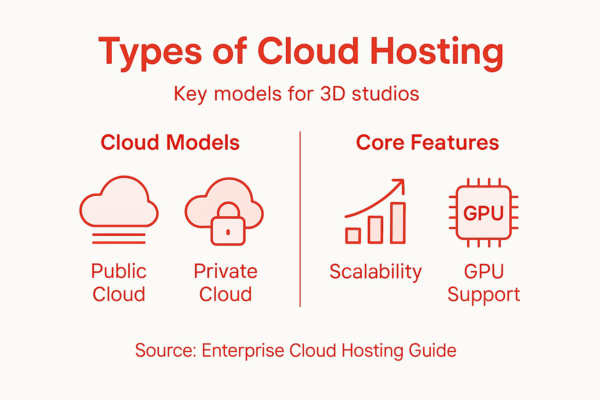
Cloud hosting fundamentally operates through several core deployment models that determine how computational resources are structured and delivered. Cloud computing deployment models typically include:
- Public Cloud: Shared infrastructure managed by third-party providers
- Private Cloud: Dedicated infrastructure for a single organization
- Hybrid Cloud: Combination of public and private cloud resources
- Community Cloud: Shared infrastructure for specific industry or collaborative groups
For 3D artists and animation studios, enterprise cloud hosting offers critical advantages that traditional infrastructure cannot match. These platforms provide instant scalability, allowing studios to rapidly expand computational capacity during intensive rendering projects without massive upfront hardware investments. Compute resources can be dynamically allocated based on project requirements, enabling studios to optimize their infrastructure spending.
The service models within enterprise cloud hosting further differentiate computational offerings. Professionals can select from Infrastructure as a Service (IaaS), Platform as a Service (PaaS), and Software as a Service (SaaS) models, each providing different levels of management and control. Cloud service architectures enable organizations to select precisely the right computational framework for their specific workflow demands.
Pro tip: Always conduct a comprehensive workflow analysis before selecting an enterprise cloud hosting provider to ensure their infrastructure matches your specific rendering and computational requirements.
Types of enterprise cloud hosting solutions
Enterprise cloud hosting solutions represent sophisticated infrastructure models designed to meet diverse computational needs across different organizational contexts. Cloud computing platforms offer multiple deployment strategies that enable businesses to select the most appropriate architecture for their specific requirements.
Cloud hosting solutions can be categorized into several primary deployment models:
- Public Cloud: Shared infrastructure managed by third-party providers
- Private Cloud: Dedicated infrastructure for single organizational use
- Hybrid Cloud: Integrated combination of public and private resources
- Multi-Cloud: Utilizing multiple cloud providers simultaneously
- Community Cloud: Shared infrastructure for specific industry groups
Enterprise cloud hosting further differentiates through service models that define the level of management and control. These service architectures include Infrastructure as a Service (IaaS), Platform as a Service (PaaS), and Software as a Service (SaaS). Each model provides progressively abstracted layers of computational resources, allowing organizations to select the most suitable approach for their technical complexity and operational requirements.
Comparative cloud platforms like Google Cloud, Microsoft Azure, and AWS offer nuanced variations in their cloud infrastructure capabilities, providing enterprises with sophisticated options for computational scaling. These providers differentiate themselves through unique features such as geographic data center locations, security protocols, storage options, and specialized computational resources tailored for specific industry needs.
Here’s how popular enterprise cloud providers compare for compute-heavy 3D studio workloads:
| Provider | Specialized Strength | Geographic Coverage | Security Certifications |
|---|---|---|---|
| AWS | Advanced GPU instances | Global data centers | SOC 2, ISO 27001, GDPR |
| Microsoft Azure | Hybrid cloud integration | Strong US/EU presence | HIPAA, FedRAMP, ISO 27018 |
| Google Cloud | AI and ML toolsets | Expanding worldwide | PCI DSS, ISO 27017, CCPA |
| European Vendors | Data sovereignty focus | Regional in EU | Schrems II, GDPR, ENISA |
Pro tip: Conduct a comprehensive technical assessment of your workflow requirements before selecting a cloud hosting solution to ensure optimal performance and cost-effectiveness.
Key features for compute-intensive workloads
Compute-intensive workloads demand specialized cloud infrastructure that can dynamically adapt to complex computational challenges faced by 3D rendering studios, AI researchers, and high-performance computing environments. Cloud workload optimizations represent critical technological advances that enable organizations to maximize computational efficiency and reliability.
Key features essential for supporting compute-intensive workflows include:
- High-Performance GPU Acceleration: Dedicated graphics processing units optimized for parallel computing
- Scalable Computational Resources: Instant vertical and horizontal scaling capabilities
- Low-Latency Network Connectivity: High-speed interconnects minimizing data transfer bottlenecks
- Advanced Storage Solutions: High-speed SSD and NVMe storage with rapid read/write capabilities
- Flexible VM Configuration: Support for spot instances, burstable virtual machines, and custom hardware profiles
Enterprise cloud platforms increasingly offer sophisticated SaaS architectures designed to address complex performance challenges. These architectures focus on creating elastic, responsive environments that can dynamically allocate computational resources based on real-time workflow demands, ensuring consistent performance during rendering, simulation, and machine learning tasks.
Advanced cloud hosting solutions for compute-intensive workloads must provide robust monitoring, predictive scaling, and intelligent resource management. This includes capabilities like automatic workload distribution, intelligent caching mechanisms, and seamless integration with existing production pipelines, enabling studios and research teams to focus on their core creative and computational objectives.
Pro tip: Develop comprehensive performance benchmarks specific to your workflow before selecting a cloud hosting solution to ensure optimal resource allocation and cost efficiency.
Real-world use cases for 3D studios
3D rendering studios increasingly rely on advanced cloud infrastructure to tackle complex computational challenges and deliver high-quality visual content across multiple industries. Enterprise technology implementations demonstrate how cloud-hosted solutions transform traditional production workflows by providing unprecedented scalability and performance capabilities.
Key real-world applications for enterprise cloud hosting in 3D studios include:
- Animation Production: Rendering large-scale animated films and series
- Architectural Visualization: Creating photorealistic building designs and urban planning models
- Product Design: Developing complex 3D prototypes for manufacturing and marketing
- Medical Imaging: Generating detailed anatomical models and surgical simulations
- Video Game Development: Rendering advanced graphics and complex game environments
Advanced AI and cloud computing models enable 3D studios to tackle increasingly complex projects by providing distributed computational resources. These technologies allow studios to break traditional hardware limitations, enabling render farms that can process massive computational tasks simultaneously across global data centers.

Enterprise cloud platforms offer unique advantages for 3D studios, including geographic flexibility, on-demand resource allocation, and seamless collaboration tools. Studios can now dynamically scale their computational resources based on project requirements, reducing infrastructure costs while maintaining high-performance rendering capabilities across diverse creative and technical domains.
Pro tip: Develop a comprehensive cloud rendering strategy that considers your specific workflow complexity, project scale, and budget constraints to maximize computational efficiency.
Evaluating performance, costs, and security
Enterprise cloud hosting requires a comprehensive assessment of performance metrics, cost structures, and security protocols to ensure optimal infrastructure for compute-intensive workflows. Cloud computing certification schemes highlight the critical importance of establishing rigorous evaluation frameworks that balance technological capabilities with regulatory compliance.
Key evaluation criteria for enterprise cloud hosting include:
- Performance Benchmarking: Measuring computational speed and rendering efficiency
- Cost Optimization: Analyzing total cost of ownership and resource utilization
- Security Compliance: Verifying data protection and regulatory adherence
- Scalability Potential: Assessing infrastructure flexibility and expansion capabilities
- Reliability Metrics: Evaluating uptime guarantees and service level agreements
Cloud computing risk assessment emphasizes the importance of understanding potential security vulnerabilities in multi-tenant environments. Enterprise 3D studios must carefully evaluate potential risks such as data breaches, service interruptions, and unauthorized access, implementing robust encryption and access control mechanisms to protect sensitive rendering projects and intellectual property.
Effective cloud hosting evaluation requires a holistic approach that combines technical performance analysis, financial modeling, and comprehensive security assessments. Studios should develop detailed comparison matrices that weight different factors based on their specific workflow requirements, ensuring that selected cloud infrastructure provides the optimal balance between computational power, cost-effectiveness, and robust security protocols.
This matrix summarizes how core evaluation factors influence cloud infrastructure selection:
| Factor | Business Impact | Studio Consideration |
|---|---|---|
| Performance | Faster project delivery | Reduces deadline risks |
| Cost Optimization | Controls long-term spending | Frees budget for creative work |
| Security | Protects intellectual property | Ensures client data confidentiality |
| Scalability | Adapts to project surges | Handles peak rendering needs |
| Reliability | Reduces downtime risk | Maintains client trust |
Pro tip: Create a weighted scoring system that prioritizes your most critical performance, security, and cost requirements when evaluating cloud hosting solutions.
Alternatives and common pitfalls to avoid
Enterprise cloud hosting strategies require careful navigation to prevent costly mistakes that can compromise performance, security, and budget efficiency. Cloud migration risks highlight critical challenges that 3D studios must proactively address when selecting computational infrastructure.
Common pitfalls in cloud hosting adoption include:
- Vendor Lock-in: Becoming overly dependent on a single provider’s ecosystem
- Underestimating Costs: Failing to account for hidden infrastructure expenses
- Inadequate Security Planning: Neglecting comprehensive data protection strategies
- Performance Miscalculation: Selecting infrastructure without proper workflow testing
- Compliance Oversights: Ignoring regional data sovereignty requirements
European cloud hosting alternatives provide compelling options for studios seeking more localized and compliant computational resources. These providers often offer enhanced data sovereignty, transparent pricing models, and specialized infrastructure tailored to specific regional regulatory requirements, presenting attractive alternatives to dominant global cloud platforms.
Successful cloud hosting strategies demand a comprehensive approach that balances technical requirements, financial constraints, and long-term scalability. Studios must conduct thorough due diligence, including detailed performance benchmarks, security assessments, and comprehensive cost modeling to mitigate potential risks and ensure optimal computational infrastructure alignment with their specific rendering and workflow needs.
Pro tip: Develop a multi-vendor strategy that allows flexible migration between cloud providers to minimize vendor lock-in and maintain computational agility.
Unlock High-Performance Enterprise Cloud Hosting for Your 3D Workflows
The article highlights the challenge of finding reliable, scalable, and secure cloud infrastructure tailored for compute-intensive workloads like 3D rendering. Studios and professionals face pain points such as unpredictable performance, hidden costs, and limited control over resources. MaxCloudON addresses these issues head on by delivering dedicated cloud servers optimized specifically for demanding tasks including AI, simulations, and complex rendering projects. With instant deployment of GPU and CPU servers and full root/admin access, you gain the agility and transparency necessary to power your enterprise workflows without compromise.
Elevate your studio’s capabilities now by exploring our comprehensive solutions that combine high-performance hardware with flexible pricing and robust security. Whether you want streamlined rendering with RenderSonic or customizable cloud compute servers, MaxCloudON supports your creative and technical ambitions. Discover detailed guides and insights in our Terms and Processes – MaxCloudON and stay informed with the latest offerings in MaxCloudON Archives – MaxCloudON. Get started today at https://maxcloudon.com and experience a cloud hosting partner that understands the unique needs of enterprise 3D workflows.
Frequently Asked Questions
What is enterprise cloud hosting?
How do different cloud deployment models affect my 3D workflow?
What are the key features to consider for compute-intensive workloads in 3D studios?
How can I evaluate the performance and costs of enterprise cloud hosting solutions?
Recommended
- What is Cloud Computing: Definition, Types and Benefits – MaxCloudON
- Private Cloud vs. Public Cloud: In-depth Comparison – MaxCloudON
- Dedicated Cloud Hosting Guide for High-Performance Tasks
- Advantages of Cloud Rendering: From Local to Remote Renders
- WordPress Ultimate: Enterprise‑Grade & Scalable | AI and Digital Marketing Service by MCNM
- Technologies That Will Make Running a Business Easier | Capital For Business